
The maths exam game.
Ten minutes of exam-style questions a day, played as a game. You see exactly which mistakes cost marks, weeks before the real exam.

Primary to IGCSE
checked every answer
A small exam every day. A clear answer for you.
- 1
Pick the syllabus
Cambridge Primary, Lower Secondary or IGCSE. “Find my level” places your child with ten quick questions. For IGCSE, add the exam date too.
- 2
They sit a small exam, as a game
Ten exam-style questions a round, on the chapter they choose. For IGCSE, all four timed papers, with and without a calculator, as the exam gets close.
- 3
You see how ready they are
A report after every session: what they have mastered, and the one mistake worth a word at dinner.
You only find out how ready they were when the results come back.
The same mistake, test after test
It gets a cross and a “careless!” in March, and again in May. Nobody says why.
Tuition teaches, but rarely tests every day
Classes teach the topic. They rarely have time to find the one rule your child got wrong.
“The exam is months away”
So practice waits for the last few weeks, when a mistake is the most expensive to fix.
Practice is a fight
Worksheets lose to games every evening. And you only find out how it went from the report card.
A wrong answer is not carelessness. It is a rule your child believes, and it keeps costing marks until someone spots it.
Every wrong answer has a reason. Huh Lab finds it.
Pick an answer, any answer. A wrong one here does not just get a cross. It gets its reason, the way your child’s will.
Then your child goes back to the step behind it, and forward again until it sticks.

What is ¼ + ¼?
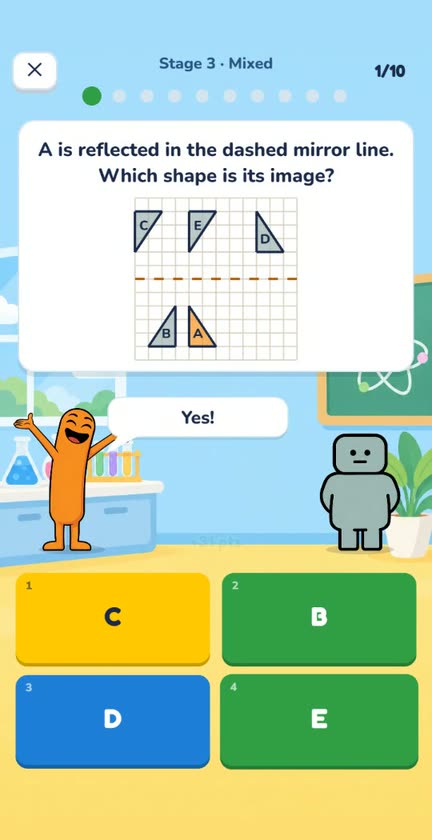
Not a maths game. An exam game.
A plan to exam day
IGCSE: give the exam date, and the weak topics are spread over the weeks left, with the last week kept for a timed paper and a review.
Timed papers
IGCSE: all four papers. Paper 1 and 3 (Core, 90 minutes), Paper 2 and 4 (Extended, 120 minutes); 3 and 4 with a calculator, answers marked to 3 significant figures. No feedback and no points until the end, then marks by topic.
Weak topics first
Every answer is checked against 335 known mistakes, so practice goes where marks are being lost.
Exam-style, every round
Ten questions in the style of the test, on the same Cambridge syllabus as school, from Stage 1 to IGCSE.
Mastery that lasts
A skill they have mastered comes back on its own, so it is still there on exam day.
Pacing, not just marks
A timed paper shows how the time went: stuck too long, rushing, or finishing early without checking.
No more asking “how was practice?”
After every session, an email: how long, how many, what they mastered, and the one mistake worth a word at dinner. Rewards wait for your OK, and the gift card code is sent to you, never shown in the game.
They play because it is a game. You approve every reward.
Real progress earns points, and points become Robux, up to 500 a month, paid by us and approved by you.
 Bit, the coachCheers every right answer, and keeps them going after a wrong one.
 Huh, the navigatorShows what each mistake was, and where to go next.
Tuition teaches. Huh Lab tests, every day.
Played as a game
Sorting, plotting, matching and typing, with Bit and Huh. Ten minutes a day is enough.
The reason, not a cross
Every answer is checked against known mistakes, then they practise the step behind it.
A report after every session
And the whole week on one page every Monday, so you always know how it is going.
It sticks until exam day
A skill they have mastered comes back on its own, so it is still there when it counts.
Their own plan, their own level
Every track from Primary to IGCSE, at your child's own level, on any phone, tablet or computer.
Safe for children
Children never register and never see a payment page. Rewards always wait for a parent.
- Cambridge Primaryages 5 to 11
- Lower Secondaryages 11 to 14
- IGCSE Maths 0580ages 14 to 16
Written to match the Cambridge curriculum; not affiliated with or endorsed by Cambridge.
One price per child. Cancel any time.
The exam is months away? Good. That is when mistakes are cheap. A mistake found this week costs nothing; the same mistake found in the final costs marks.
And if it does not work? Then it costs you nothing.
Not right for your family? Email support@huhlab.com within 30 days of your first payment for a full refund, as long as no Robux reward has been claimed. Even Huh agrees that is fair.
Not sure yet?
Let them try a few questions as a guest, or read the reports of our demo family first.
Huh Lab Maths
About RM167 a month, charged in US dollars. Your first month comes with 15 extra days free on top.
- All three tracks: Primary, Lower Secondary, IGCSE
- Per child, each at their own level. Add brothers and sisters to the same account
- The reason behind every wrong answer
- A report after every session, and every Monday
- Robux rewards, approved by you
- Phone, tablet or computer
- 30-day money-back guarantee
🔒 Secure payment by Stripe · Or pay yearly: one month free.
What parents ask first.
Is this a replacement for tuition?
No. Tuition teaches. Huh Lab is where your child sits a small exam every day, as a game, on the same syllabus as school, so you can see what the tuition has fixed and what it has not.
Does it follow my child’s school syllabus?
It is written to match the Cambridge curriculum used in international schools: Primary (stages 1 to 6), Lower Secondary (stages 7 to 9) and IGCSE Maths 0580. Pick the stage your child is in; you can change it any time.
How long a day?
A session is 5 to 15 minutes. Ten minutes a day is enough, and the report tells you exactly how long they played.
Is there a free trial?
There is no free trial. You pay for the first month and it comes with 15 extra days free on top. A guest can try a few questions first, and the 30-day guarantee covers the rest.
How do the Robux rewards work?
Real progress earns points. When your child has enough, you get an email and decide. The gift card code is sent to you, never shown in the game.
Exam day shouldn’t be the first time you find out.
Ten minutes a day, a report after every session, and a refund if it is not for you. From “huh?” to “oh, I get it!”